How to Draw Free Body Diagram in Mechanics
5 Newton's Laws of Motion
5.7 Drawing Free-Body Diagrams
Learning Objectives
Past the end of the section, you volition be able to:
- Explain the rules for cartoon a free-torso diagram
- Construct gratuitous-body diagrams for different situations
The first step in describing and analyzing most phenomena in physics involves the careful drawing of a costless-body diagram. Free-body diagrams have been used in examples throughout this chapter. Remember that a complimentary-torso diagram must simply include the external forces acting on the body of interest. One time nosotros have fatigued an authentic free-body diagram, we can apply Newton's first constabulary if the trunk is in equilibrium (balanced forces; that is, [latex]{F}_{\text{net}}=0[/latex]) or Newton's second law if the body is accelerating (unbalanced strength; that is, [latex]{F}_{\text{net}}\ne 0[/latex]).
In Forces, we gave a brief problem-solving strategy to assist you understand complimentary-trunk diagrams. Here, we add together some details to the strategy that will help you in constructing these diagrams.
Problem-Solving Strategy: Constructing Costless-Body Diagrams
Notice the following rules when constructing a gratuitous-body diagram:
- Describe the object under consideration; it does not have to be creative. At outset, yous may want to describe a circle effectually the object of interest to be sure you focus on labeling the forces acting on the object. If you are treating the object as a particle (no size or shape and no rotation), represent the object as a indicate. We oft place this point at the origin of an xy-coordinate system.
- Include all forces that human activity on the object, representing these forces as vectors. Consider the types of forces described in Common Forces—normal strength, friction, tension, and spring force—as well as weight and practical strength. Do non include the net force on the object. With the exception of gravity, all of the forces nosotros have discussed crave direct contact with the object. However, forces that the object exerts on its environment must not be included. We never include both forces of an action-reaction pair.
- Catechumen the free-trunk diagram into a more detailed diagram showing the 10– and y-components of a given forcefulness (this is often helpful when solving a problem using Newton's first or second police force). In this case, place a squiggly line through the original vector to show that information technology is no longer in play—it has been replaced by its 10– and y-components.
- If there are two or more than objects, or bodies, in the problem, draw a dissever gratis-torso diagram for each object.
Note: If there is acceleration, we do not directly include it in the free-body diagram; however, information technology may help to indicate acceleration outside the free-body diagram. Y'all can label information technology in a dissimilar color to betoken that it is separate from the gratuitous-body diagram.
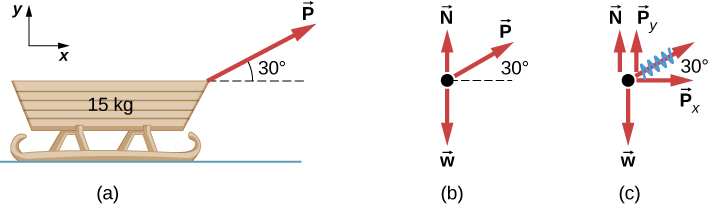
Let'southward apply the problem-solving strategy in cartoon a complimentary-body diagram for a sled. In Effigy(a), a sled is pulled by force P at an bending of [latex]xxx^\circ[/latex]. In part (b), we show a free-torso diagram for this situation, as described by steps 1 and 2 of the problem-solving strategy. In part (c), we bear witness all forces in terms of their x– and y-components, in keeping with stride 3.
Example
Two Blocks on an Inclined Plane
Construct the free-body diagram for object A and object B in Figure.
Strategy
We follow the four steps listed in the problem-solving strategy.
Solution
We start by creating a diagram for the first object of interest. In Effigy(a), object A is isolated (circled) and represented by a dot.
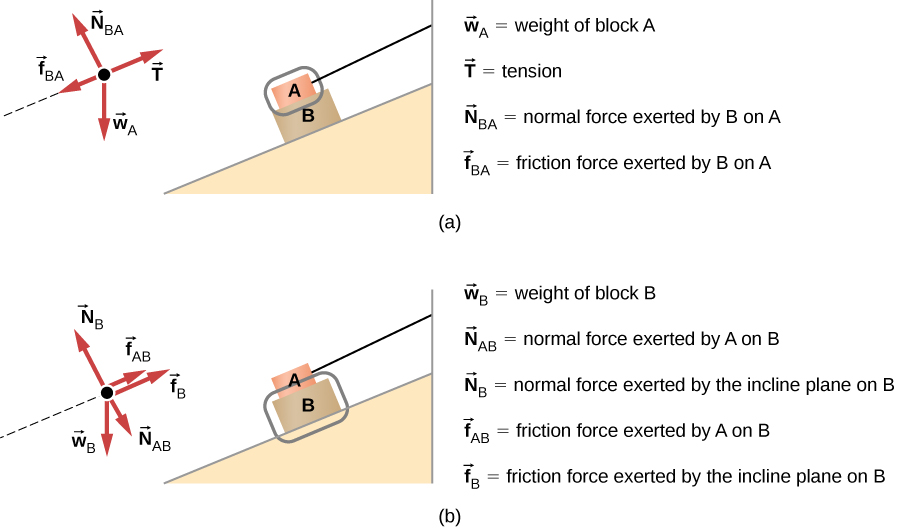
We at present include whatever force that acts on the body. Here, no applied force is present. The weight of the object acts as a strength pointing vertically downwardly, and the presence of the cord indicates a force of tension pointing away from the object. Object A has i interface and hence experiences a normal force, directed away from the interface. The source of this forcefulness is object B, and this normal strength is labeled accordingly. Since object B has a tendency to slide down, object A has a tendency to slide up with respect to the interface, so the friction [latex]{f}_{\text{BA}}[/latex] is directed downwardly parallel to the inclined plane.
Equally noted in step 4 of the problem-solving strategy, we then construct the free-body diagram in Figure(b) using the same arroyo. Object B experiences ii normal forces and two friction forces due to the presence of two contact surfaces. The interface with the inclined plane exerts external forces of [latex]{N}_{\text{B}}[/latex] and [latex]{f}_{\text{B}}[/latex], and the interface with object B exerts the normal forcefulness [latex]{Due north}_{\text{AB}}[/latex] and friction [latex]{f}_{\text{AB}}[/latex]; [latex]{N}_{\text{AB}}[/latex] is directed away from object B, and [latex]{f}_{\text{AB}}[/latex] is opposing the tendency of the relative motility of object B with respect to object A.
Significance
The object nether consideration in each part of this trouble was circled in greyness. When you are first learning how to depict costless-body diagrams, y'all will detect it helpful to circumvolve the object before deciding what forces are acting on that detail object. This focuses your attention, preventing you from considering forces that are not acting on the body.
Case
Two Blocks in Contact
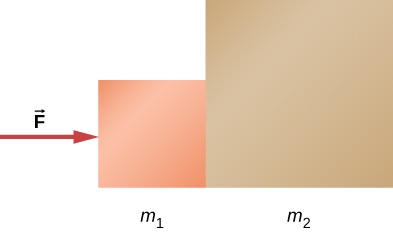
A forcefulness is applied to two blocks in contact, every bit shown.
Strategy
Depict a gratis-body diagram for each block. Be certain to consider Newton's tertiary law at the interface where the 2 blocks touch.
Solution
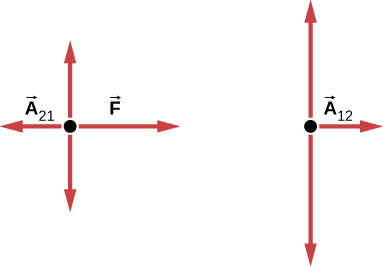
Significance[latex]{\mathbf{\overset{\to }{A}}}_{21}[/latex] is the activeness strength of cake 2 on block ane. [latex]{\mathbf{\overset{\to }{A}}}_{12}[/latex] is the reaction force of block i on block ii. Nosotros employ these gratuitous-body diagrams in Applications of Newton'southward Laws.
Case
Block on the Tabular array (Coupled Blocks)
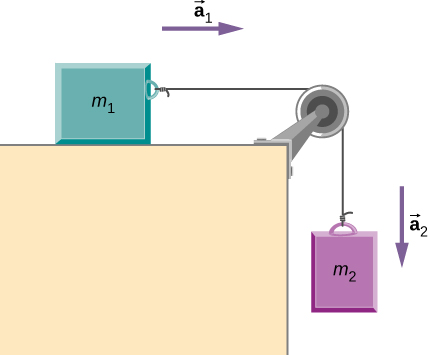
A block rests on the table, as shown. A light rope is attached to it and runs over a caster. The other end of the rope is attached to a 2nd block. The two blocks are said to exist coupled. Block [latex]{m}_{2}[/latex] exerts a forcefulness due to its weight, which causes the system (two blocks and a string) to accelerate.
Strategy
Nosotros assume that the string has no mass so that we do not take to consider information technology every bit a separate object. Draw a complimentary-trunk diagram for each block.
Solution
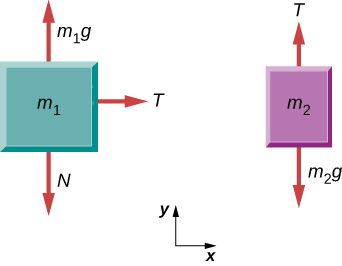
Significance
Each cake accelerates (notice the labels shown for [latex]{\mathbf{\overset{\to }{a}}}_{i}[/latex] and [latex]{\mathbf{\overset{\to }{a}}}_{2}[/latex]); however, assuming the string remains taut, they accelerate at the aforementioned rate. Thus, we have [latex]{\mathbf{\overset{\to }{a}}}_{1}={\mathbf{\overset{\to }{a}}}_{2}[/latex]. If we were to go along solving the problem, we could but telephone call the acceleration [latex]\mathbf{\overset{\to }{a}}[/latex]. Also, nosotros use two free-body diagrams because nosotros are usually finding tension T, which may require u.s. to employ a system of 2 equations in this type of trouble. The tension is the aforementioned on both [latex]{m}_{ane}\,\text{and}\,{thou}_{2}[/latex].
Check Your Understanding
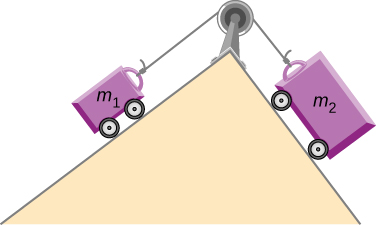
(a) Draw the free-body diagram for the state of affairs shown. (b) Redraw it showing components; use x-axes parallel to the two ramps.
Show Solution
Figure a shows a free body diagram of an object on a line that slopes downwardly to the correct. Arrow T from the object points right and up, parallel to the slope. Pointer N1 points left and upward, perpendicular to the slope. Pointer w1 points vertically downwardly. Pointer w1x points left and downward, parallel to the slope. Arrow w1y points right and downwardly, perpendicular to the slope. Figure b shows a complimentary body diagram of an object on a line that slopes down to the left. Pointer N2 from the object points right and up, perpendicular to the slope. Pointer T points left and up, parallel to the slope. Arrow w2 points vertically downward. Pointer w2y points left and downwardly, perpendicular to the gradient. Arrow w2x points right and downward, parallel to the slope.
View this simulation to predict, qualitatively, how an external force will affect the speed and direction of an object's motion. Explicate the furnishings with the assist of a gratis-body diagram. Use free-torso diagrams to draw position, velocity, acceleration, and force graphs, and vice versa. Explain how the graphs relate to 1 another. Given a scenario or a graph, sketch all 4 graphs.
Summary
- To depict a free-body diagram, we draw the object of interest, draw all forces interim on that object, and resolve all force vectors into x– and y-components. Nosotros must draw a separate free-body diagram for each object in the problem.
- A free-trunk diagram is a useful means of describing and analyzing all the forces that act on a body to determine equilibrium according to Newton'southward first constabulary or acceleration according to Newton's 2nd law.
Key Equations
| Net external force | [latex]{\mathbf{\overset{\to }{F}}}_{\text{cyberspace}}=\sum \mathbf{\overset{\to }{F}}={\mathbf{\overset{\to }{F}}}_{1}+{\mathbf{\overset{\to }{F}}}_{2}+\cdots[/latex] |
| Newton'due south first police force | [latex]\mathbf{\overset{\to }{5}}=\,\text{constant when}\,{\mathbf{\overset{\to }{F}}}_{\text{net}}=\mathbf{\overset{\to }{0}}\,\text{N}[/latex] |
| Newton'southward second constabulary, vector grade | [latex]{\mathbf{\overset{\to }{F}}}_{\text{net}}=\sum \mathbf{\overset{\to }{F}}=1000\mathbf{\overset{\to }{a}}[/latex] |
| Newton's 2d law, scalar form | [latex]{F}_{\text{net}}=ma[/latex] |
| Newton's second police force, component class | [latex]\sum {\mathbf{\overset{\to }{F}}}_{x}=thou{\mathbf{\overset{\to }{a}}}_{x}\text{,}\,\sum {\mathbf{\overset{\to }{F}}}_{y}=thou{\mathbf{\overset{\to }{a}}}_{y},\,\text{and}\,\sum {\mathbf{\overset{\to }{F}}}_{z}=g{\mathbf{\overset{\to }{a}}}_{z}.[/latex] |
| Newton's second police force, momentum form | [latex]{\mathbf{\overset{\to }{F}}}_{\text{cyberspace}}=\frac{d\mathbf{\overset{\to }{p}}}{dt}[/latex] |
| Definition of weight, vector course | [latex]\mathbf{\overset{\to }{w}}=g\mathbf{\overset{\to }{g}}[/latex] |
| Definition of weight, scalar grade | [latex]w=mg[/latex] |
| Newton's tertiary law | [latex]{\mathbf{\overset{\to }{F}}}_{\text{AB}}=\text{−}{\mathbf{\overset{\to }{F}}}_{\text{BA}}[/latex] |
| Normal strength on an object resting on a horizontal surface, vector course | [latex]\mathbf{\overset{\to }{Due north}}=\text{−}k\mathbf{\overset{\to }{chiliad}}[/latex] |
| Normal strength on an object resting on a horizontal surface, scalar class | [latex]N=mg[/latex] |
| Normal force on an object resting on an inclined plane, scalar form | [latex]Northward=mg\text{cos}\,\theta[/latex] |
| Tension in a cablevision supporting an object of mass m at remainder, scalar form | [latex]T=westward=mg[/latex] |
Conceptual Questions
In completing the solution for a problem involving forces, what do we do after constructing the complimentary-torso diagram? That is, what do we employ?
If a book is located on a table, how many forces should be shown in a gratis-torso diagram of the volume? Draw them.
Show Solution
Two forces of dissimilar types: weight acting downward and normal strength acting upward
If the volume in the previous question is in costless fall, how many forces should be shown in a free-body diagram of the book? Describe them.
Problems
A brawl of mass m hangs at rest, suspended by a cord. (a) Sketch all forces. (b) Describe the free-body diagram for the ball.
A auto moves along a horizontal route. Draw a free-body diagram; exist sure to include the friction of the road that opposes the frontward motion of the car.
Show Solution
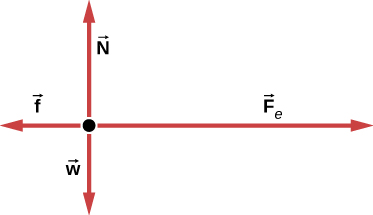
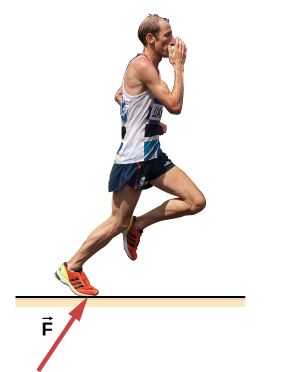
A runner pushes against the runway, as shown. (a) Provide a free-body diagram showing all the forces on the runner. (Hint: Place all forces at the center of his body, and include his weight.) (b) Requite a revised diagram showing the xy-component form.
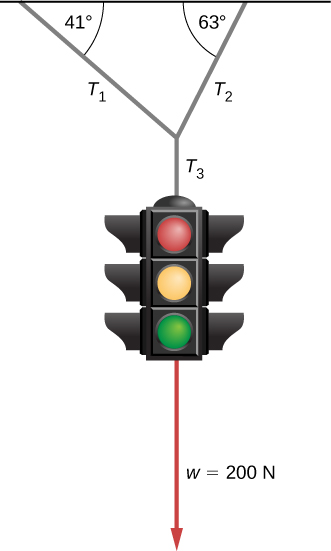
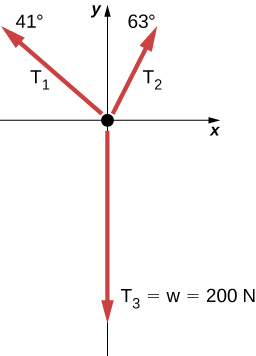
The traffic light hangs from the cables every bit shown. Draw a free-body diagram on a coordinate plane for this situation.
Testify Solution
Boosted Problems
Two pocket-sized forces, [latex]{\mathbf{\overset{\to }{F}}}_{1}=-2.40\mathbf{\hat{i}}-6.10t\mathbf{\lid{j}}[/latex] N and [latex]{\mathbf{\overset{\to }{F}}}_{ii}=8.50\mathbf{\hat{i}}-ix.lxx\mathbf{\lid{j}}[/latex] Northward, are exerted on a rogue asteroid by a pair of space tractors. (a) Discover the net force. (b) What are the magnitude and management of the cyberspace forcefulness? (c) If the mass of the asteroid is 125 kg, what dispatch does it feel (in vector form)? (d) What are the magnitude and direction of the acceleration?
Two forces of 25 and 45 Northward human action on an object. Their directions differ by [latex]seventy^\circ[/latex]. The resulting acceleration has magnitude of [latex]10.0\,{\text{thou/south}}^{two}.[/latex] What is the mass of the body?
A force of 1600 N acts parallel to a ramp to push a 300-kg piano into a moving van. The ramp is inclined at [latex]20^\circ[/latex]. (a) What is the acceleration of the piano up the ramp? (b) What is the velocity of the piano when information technology reaches the elevation if the ramp is iv.0 m long and the piano starts from rest?
Draw a costless-torso diagram of a diver who has entered the water, moved downward, and is acted on by an upwardly force due to the water which balances the weight (that is, the diver is suspended).
Bear witness Solution

For a swimmer who has merely jumped off a diving lath, assume air resistance is negligible. The swimmer has a mass of fourscore.0 kg and jumps off a lath 10.0 one thousand above the water. 3 seconds after entering the h2o, her downwards motion is stopped. What average upward force did the water exert on her?
(a) Observe an equation to determine the magnitude of the cyberspace force required to stop a car of mass m, given that the initial speed of the car is [latex]{5}_{0}[/latex] and the stopping distance is x. (b) Discover the magnitude of the net force if the mass of the car is 1050 kg, the initial speed is 40.0 km/h, and the stopping distance is 25.0 chiliad.
Evidence Solution
a. [latex]{F}_{\text{net}}=\frac{m({v}^{2}-{v}_{0}{}^{2})}{2x}[/latex]; b. 2590 N
A sailboat has a mass of [latex]ane.fifty\times {x}^{three}[/latex] kg and is acted on past a forcefulness of [latex]2.00\times {10}^{3}[/latex] N toward the east, while the wind acts backside the sails with a force of [latex]3.00\times {x}^{3}[/latex] N in a direction [latex]45^\circ[/latex] north of east. Find the magnitude and management of the resulting dispatch.
Notice the acceleration of the body of mass 10.0 kg shown below.
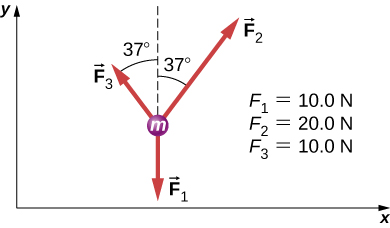
Show Answer
[latex]\begin{array}{cc} {\mathbf{\overset{\to }{F}}}_{\text{net}}=4.05\mathbf{\hat{i}}+12.0\mathbf{\hat{j}}\text{N}\hfill \\ {\mathbf{\overset{\to }{F}}}_{\text{internet}}=thou\mathbf{\overset{\to }{a}}\Rightarrow \mathbf{\overset{\to }{a}}=0.405\mathbf{\hat{i}}+1.xx\mathbf{\hat{j}}\,{\text{g/s}}^{2}\hfill \end{array}[/latex]
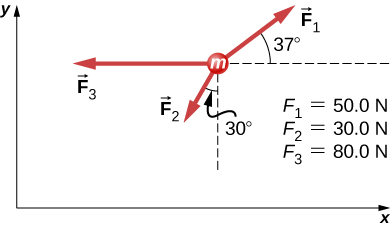
A body of mass 2.0 kg is moving along the 10-centrality with a speed of iii.0 m/due south at the instant represented below. (a) What is the acceleration of the body? (b) What is the body's velocity 10.0 s afterwards? (c) What is its displacement after 10.0 south?
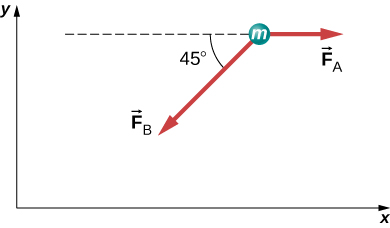
Forcefulness [latex]{\mathbf{\overset{\to }{F}}}_{\text{B}}[/latex] has twice the magnitude of force [latex]{\mathbf{\overset{\to }{F}}}_{\text{A}}.[/latex] Find the direction in which the particle accelerates in this figure.
Show Answer
[latex]\begin{array}{cc} {\mathbf{\overset{\to }{F}}}_{\text{net}}={\mathbf{\overset{\to }{F}}}_{\text{A}}+{\mathbf{\overset{\to }{F}}}_{\text{B}}\hfill \\ {\mathbf{\overset{\to }{F}}}_{\text{net}}=A\mathbf{\hat{i}}+(-i.41A\mathbf{\hat{i}}-1.41A\mathbf{\hat{j}})\hfill \\ {\mathbf{\overset{\to }{F}}}_{\text{net}}=A(-0.41\mathbf{\hat{i}}-1.41\mathbf{\chapeau{j}})\hfill \\ \theta =254^\circ\hfill \stop{assortment}[/latex]
(Nosotros add [latex]180^\circ[/latex], because the angle is in quadrant IV.)
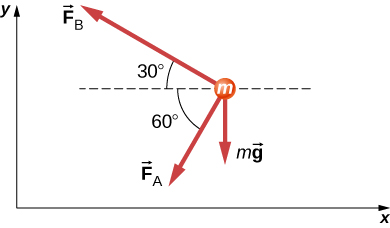
Shown below is a trunk of mass 1.0 kg nether the influence of the forces [latex]{\mathbf{\overset{\to }{F}}}_{A}[/latex], [latex]{\mathbf{\overset{\to }{F}}}_{B}[/latex], and [latex]m\mathbf{\overset{\to }{grand}}[/latex]. If the torso accelerates to the left at [latex]20\,{\text{chiliad/south}}^{2}[/latex], what are [latex]{\mathbf{\overset{\to }{F}}}_{A}[/latex] and [latex]{\mathbf{\overset{\to }{F}}}_{B}[/latex]?
A force acts on a motorcar of mass thou so that the speed v of the car increases with position x equally [latex]v=grand{10}^{two}[/latex], where thou is abiding and all quantities are in SI units. Find the strength acting on the car as a function of position.
Show Solution
[latex]F=2kmx[/latex]; First, take the derivative of the velocity function to obtain [latex]a=2kx[/latex]. Then apply Newton's 2d law [latex]F=ma=one thousand(2kx)=2kmx[/latex].
A 7.0-North force parallel to an incline is practical to a 1.0-kg crate. The ramp is tilted at [latex]20^\circ[/latex] and is frictionless. (a) What is the acceleration of the crate? (b) If all other weather are the same only the ramp has a friction forcefulness of i.9 N, what is the acceleration?
Two boxes, A and B, are at residue. Box A is on level ground, while box B rests on an inclined plane tilted at angle [latex]\theta[/latex] with the horizontal. (a) Write expressions for the normal force acting on each block. (b) Compare the ii forces; that is, tell which one is larger or whether they are equal in magnitude. (c) If the bending of incline is [latex]10^\circ[/latex], which forcefulness is greater?
Show Solution
a. For box A, [latex]{North}_{\text{A}}=mg[/latex] and [latex]{Due north}_{\text{B}}=mg\,\text{cos}\,\theta[/latex]; b. [latex]{N}_{\text{A}} \gt {N}_{\text{B}}[/latex] because for [latex]\theta \lt 90^\circ[/latex], [latex]\text{cos}\,\theta \lt one[/latex]; c. [latex]{N}_{\text{A}} \gt {N}_{\text{B}}[/latex] when [latex]\theta =10^\circ[/latex]
A mass of 250.0 g is suspended from a spring hanging vertically. The leap stretches 6.00 cm. How much will the spring stretch if the suspended mass is 530.0 m?
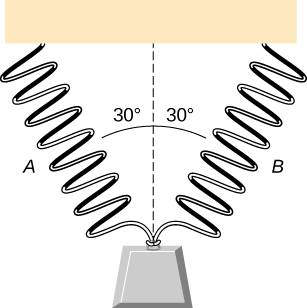
As shown below, two identical springs, each with the spring constant twenty N/m, support a 15.0-Due north weight. (a) What is the tension in bound A? (b) What is the amount of stretch of spring A from the residuum position?
Testify Solution
a. eight.66 N; b. 0.433 m
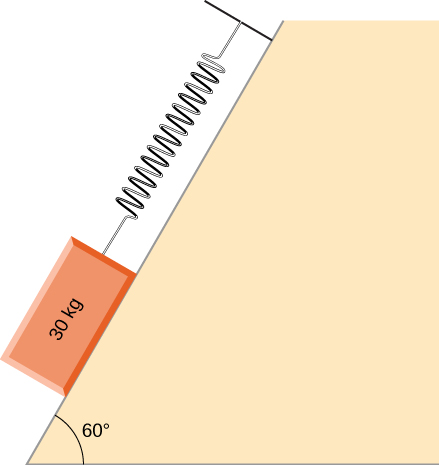
Shown below is a 30.0-kg block resting on a frictionless ramp inclined at [latex]60^\circ[/latex] to the horizontal. The block is held by a spring that is stretched 5.0 cm. What is the force constant of the spring?
In edifice a house, carpenters use nails from a big box. The box is suspended from a spring twice during the mean solar day to measure the usage of nails. At the beginning of the day, the jump stretches 50 cm. At the end of the twenty-four hour period, the spring stretches 30 cm. What fraction or percentage of the nails have been used?
Show Solution
0.twoscore or twoscore%
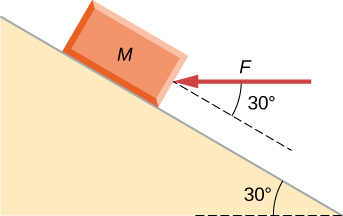
A forcefulness is applied to a cake to move it up a [latex]30^\circ[/latex] incline. The incline is frictionless. If [latex]F=65.0\,\text{N}[/latex] and [latex]M=5.00\,\text{kg}[/latex], what is the magnitude of the acceleration of the block?
Ii forces are applied to a v.0-kg object, and information technology accelerates at a rate of [latex]2.0\,{\text{m/south}}^{2}[/latex] in the positive y-direction. If 1 of the forces acts in the positive 10-direction with magnitude 12.0 Northward, detect the magnitude of the other force.
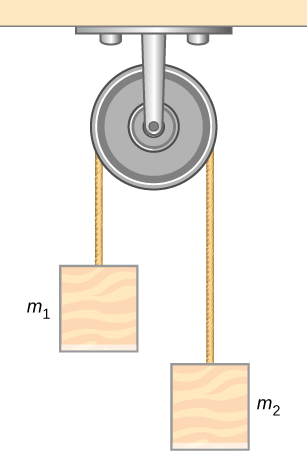
The block on the right shown below has more than mass than the cake on the left ([latex]{one thousand}_{2} \gt {m}_{ane}[/latex]). Describe costless-body diagrams for each block.
Challenge Problems
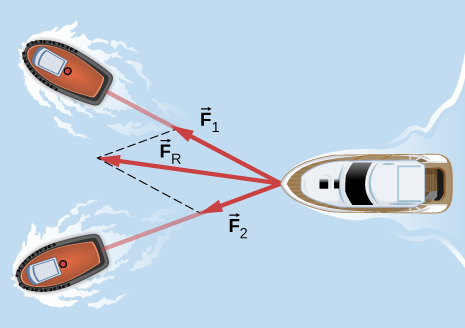
If ii tugboats pull on a disabled vessel, as shown hither in an overhead view, the disabled vessel will be pulled forth the direction indicated by the effect of the exerted forces. (a) Depict a free-trunk diagram for the vessel. Assume no friction or drag forces bear on the vessel. (b) Did you include all forces in the overhead view in your free-trunk diagram? Why or why non?
Show Solution
a.
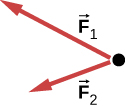
b. No; [latex]{\mathbf{\overset{\to }{F}}}_{\text{R}}[/latex] is not shown, considering it would replace [latex]{\mathbf{\overset{\to }{F}}}_{ane}[/latex] and [latex]{\mathbf{\overset{\to }{F}}}_{2}[/latex]. (If nosotros want to bear witness it, nosotros could depict it and so place squiggly lines on [latex]{\mathbf{\overset{\to }{F}}}_{1}[/latex] and [latex]{\mathbf{\overset{\to }{F}}}_{two}[/latex] to prove that they are no longer considered.
A x.0-kg object is initially moving east at fifteen.0 k/s. And so a force acts on it for 2.00 southward, after which information technology moves northwest, also at 15.0 m/s. What are the magnitude and direction of the boilerplate forcefulness that acted on the object over the two.00-due south interval?
On June 25, 1983, shot-doodle Udo Beyer of East Frg threw the 7.26-kg shot 22.22 1000, which at that time was a world record. (a) If the shot was released at a acme of 2.20 m with a projection angle of [latex]45.0^\circ[/latex], what was its initial velocity? (b) If while in Beyer'due south paw the shot was accelerated uniformly over a distance of 1.20 m, what was the cyberspace forcefulness on it?
Bear witness Solution
a. fourteen.1 m/south; b. 601 N
A trunk of mass grand moves in a horizontal direction such that at time t its position is given by [latex]x(t)=a{t}^{4}+b{t}^{iii}+ct,[/latex] where a, b, and c are constants. (a) What is the acceleration of the body? (b) What is the time-dependent forcefulness interim on the body?
A body of mass k has initial velocity [latex]{v}_{0}[/latex] in the positive x-management. It is acted on by a abiding force F for time t until the velocity becomes cypher; the force continues to act on the body until its velocity becomes [latex]\text{−}{v}_{0}[/latex] in the same amount of time. Write an expression for the total distance the body travels in terms of the variables indicated.
Prove Solution
[latex]\frac{F}{chiliad}{t}^{ii}[/latex]
The velocities of a three.0-kg object at [latex]t=6.0\,\text{southward}[/latex] and [latex]t=viii.0\,\text{s}[/latex] are [latex](3.0\mathbf{\hat{i}}-six.0\mathbf{\chapeau{j}}+four.0\mathbf{\hat{grand}})\,\text{chiliad/s}[/latex] and [latex](-2.0\mathbf{\hat{i}}+4.0\mathbf{\chapeau{chiliad}})\,\text{one thousand/due south}[/latex], respectively. If the object is moving at constant dispatch, what is the force acting on it?
A 120-kg astronaut is riding in a rocket sled that is sliding along an inclined airplane. The sled has a horizontal component of acceleration of [latex]five.0\,\text{m}\text{/}{\text{southward}}^{2}[/latex] and a down component of [latex]3.8\,\text{m}\text{/}{\text{southward}}^{2}[/latex]. Summate the magnitude of the forcefulness on the rider by the sled. (Hint: Retrieve that gravitational dispatch must be considered.)
Ii forces are interim on a 5.0-kg object that moves with acceleration [latex]2.0\,{\text{m/s}}^{ii}[/latex] in the positive y-direction. If one of the forces acts in the positive ten-direction and has magnitude of 12 N, what is the magnitude of the other forcefulness?
Suppose that yous are viewing a soccer game from a helicopter above the playing field. 2 soccer players simultaneously kick a stationary soccer ball on the flat field; the soccer ball has mass 0.420 kg. The first player kicks with force 162 N at [latex]9.0^\circ[/latex] north of west. At the aforementioned instant, the second role player kicks with force 215 Northward at [latex]15^\circ[/latex] eastward of due south. Find the acceleration of the brawl in [latex]\mathbf{\lid{i}}[/latex] and [latex]\mathbf{\lid{j}}[/latex] form.
Prove Solution
[latex]\mathbf{\overset{\to }{a}}=-248\mathbf{\chapeau{i}}-433\mathbf{\lid{j}}\text{m}\text{/}{\text{s}}^{2}[/latex]
A 10.0-kg mass hangs from a spring that has the spring constant 535 N/m. Find the position of the end of the bound away from its rest position. (Use [latex]grand=9.fourscore\,{\text{chiliad/due south}}^{two}[/latex].)
A 0.0502-kg pair of fuzzy dice is attached to the rearview mirror of a car by a short string. The car accelerates at constant charge per unit, and the die hang at an angle of [latex]3.twenty^\circ[/latex] from the vertical considering of the machine's acceleration. What is the magnitude of the acceleration of the auto?
Show Solution
[latex]0.548\,{\text{m/s}}^{2}[/latex]
At a circus, a donkey pulls on a sled carrying a small clown with a force given by [latex]2.48\mathbf{\chapeau{i}}+4.33\mathbf{\hat{j}}\,\text{N}[/latex]. A equus caballus pulls on the aforementioned sled, aiding the hapless ass, with a force of [latex]6.56\mathbf{\chapeau{i}}+v.33\mathbf{\hat{j}}\,\text{Due north}[/latex]. The mass of the sled is 575 kg. Using [latex]\mathbf{\hat{i}}[/latex] and [latex]\mathbf{\chapeau{j}}[/latex] class for the answer to each problem, find (a) the internet force on the sled when the two animals act together, (b) the acceleration of the sled, and (c) the velocity afterwards 6.50 s.
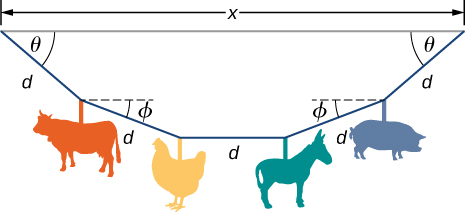
Hanging from the ceiling over a baby bed, well out of babe's achieve, is a string with plastic shapes, as shown here. The string is taut (there is no slack), as shown by the straight segments. Each plastic shape has the same mass m, and they are as spaced by a distance d, every bit shown. The angles labeled [latex]\theta[/latex] draw the bending formed past the finish of the string and the ceiling at each end. The heart length of sting is horizontal. The remaining ii segments each form an bending with the horizontal, labeled [latex]\varphi[/latex]. Let [latex]{T}_{i}[/latex] exist the tension in the leftmost section of the string, [latex]{T}_{2}[/latex] be the tension in the department next to it, and [latex]{T}_{3}[/latex] be the tension in the horizontal segment. (a) Detect an equation for the tension in each section of the string in terms of the variables m, g, and [latex]\theta[/latex]. (b) Notice the angle [latex]\varphi[/latex] in terms of the angle [latex]\theta[/latex]. (c) If [latex]\theta =5.10^\circ[/latex], what is the value of [latex]\varphi[/latex]? (d) Find the distance x between the endpoints in terms of d and [latex]\theta[/latex].
Show Solution
a. [latex]{T}_{1}=\frac{2mg}{\text{sin}\,\theta }[/latex], [latex]{T}_{2}=\frac{mg}{\text{sin}(\text{arctan}(\frac{ane}{2}\text{tan}\,\theta ))}[/latex], [latex]{T}_{3}=\frac{2mg}{\text{tan}\,\theta };[/latex] b. [latex]\varphi =\text{arctan}(\frac{1}{2}\text{tan}\,\theta )[/latex]; c. [latex]2.56^\circ[/latex]; (d) [latex]x=d(2\,\text{cos}\,\theta +2\,\text{cos}(\text{arctan}(\frac{ane}{ii}\text{tan}\,\theta ))+1)[/latex]
A bullet shot from a rifle has mass of x.0 g and travels to the right at 350 one thousand/s. It strikes a target, a big purse of sand, penetrating it a distance of 34.0 cm. Discover the magnitude and direction of the retarding forcefulness that slows and stops the bullet.
An object is acted on by three simultaneous forces: [latex]{\mathbf{\overset{\to }{F}}}_{i}=(-3.00\mathbf{\hat{i}}+2.00\mathbf{\hat{j}})\,\text{Due north}[/latex], [latex]{\mathbf{\overset{\to }{F}}}_{2}=(6.00\mathbf{\hat{i}}-4.00\mathbf{\hat{j}})\,\text{Due north}[/latex], and [latex]{\mathbf{\overset{\to }{F}}}_{three}=(ii.00\mathbf{\hat{i}}+v.00\mathbf{\lid{j}})\,\text{N}[/latex]. The object experiences acceleration of [latex]4.23\,{\text{chiliad/due south}}^{2}[/latex]. (a) Find the acceleration vector in terms of m. (b) Discover the mass of the object. (c) If the object begins from rest, notice its speed after 5.00 due south. (d) Find the components of the velocity of the object afterward v.00 s.
Show Solution
a. [latex]\mathbf{\overset{\to }{a}}=(\frac{5.00}{m}\mathbf{\hat{i}}+\frac{iii.00}{m}\mathbf{\hat{j}})\,\text{chiliad}\text{/}{\text{south}}^{2};[/latex] b. 1.38 kg; c. 21.2 m/s; d. [latex]\mathbf{\overset{\to }{v}}=(18.one\mathbf{\hat{i}}+10.ix\mathbf{\hat{j}})\,\text{chiliad}\text{/}{\text{s}}^{2}[/latex]
In a particle accelerator, a proton has mass [latex]1.67\times {10}^{-27}\,\text{kg}[/latex] and an initial speed of [latex]2.00\times {10}^{5}\,\text{m}\text{/}\text{s.}[/latex] Information technology moves in a directly line, and its speed increases to [latex]9.00\times {ten}^{5}\,\text{k}\text{/}\text{s}[/latex] in a altitude of 10.0 cm. Assume that the acceleration is constant. Find the magnitude of the strength exerted on the proton.
A drone is beingness directed across a frictionless ice-covered lake. The mass of the drone is 1.fifty kg, and its velocity is [latex]iii.00\mathbf{\chapeau{i}}\text{m}\text{/}\text{due south}[/latex]. After 10.0 s, the velocity is [latex]9.00\mathbf{\chapeau{i}}+4.00\mathbf{\chapeau{j}}\text{m}\text{/}\text{s}[/latex]. If a constant force in the horizontal direction is causing this change in motion, notice (a) the components of the force and (b) the magnitude of the force.
Testify Solution
a. [latex]0.900\mathbf{\hat{i}}+0.600\mathbf{\hat{j}}\,\text{N}[/latex]; b. 1.08 N
Source: https://pressbooks.online.ucf.edu/phy2048tjb/chapter/5-7-drawing-free-body-diagrams/

Postar um comentário for "How to Draw Free Body Diagram in Mechanics"